
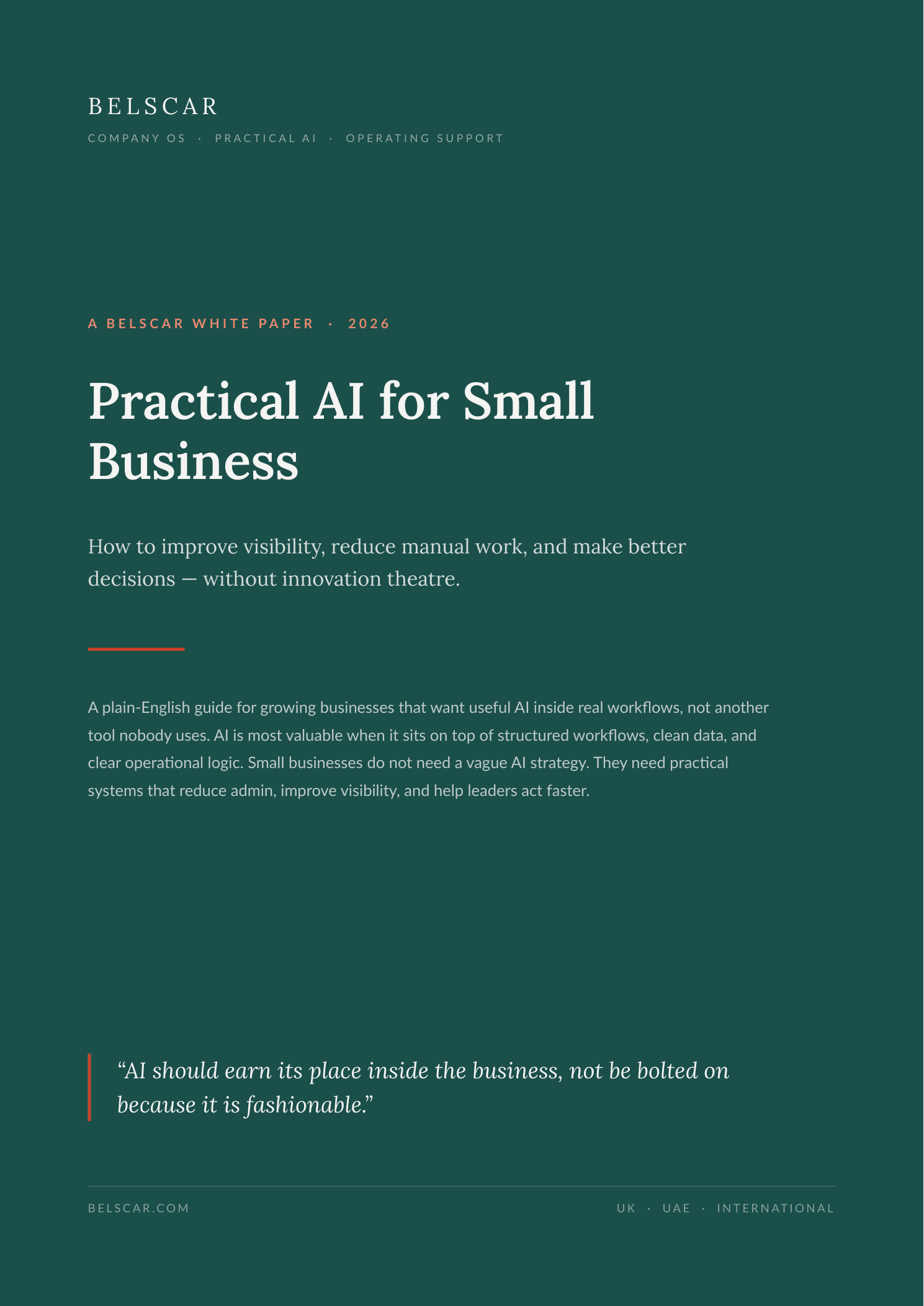
Practical AI for Small Business
How to improve visibility, reduce manual work, and make better decisions without innovation theatre.
For owners and leadership teams of growing businesses still running important work through spreadsheets, inboxes, and disconnected tools. The guide is written to help you find where AI can create practical benefit, and where the operating layer needs attention first.
01
The AI opportunity is operational, not theatrical.
02
AI pays back only after the operating layer is fixed.
03
Pace beats ambition: one workflow, 60 days, then expand.
AI becomes useful when it shortens a workflow the business already cares about: reporting, handovers, exception checks, customer response, document preparation, or decisions that are currently delayed by unclear information.
That is why this whitepaper starts with operating reality rather than tools. If a business has fragile workflows, inconsistent data, unclear ownership, or manual checking everywhere, AI will usually amplify the confusion. Fix the operating layer first, then apply AI where it can be checked, measured, and trusted.
What's inside
The practical sequence
The strongest first AI use case is rarely the flashiest one. It is usually the workflow with enough value to matter, enough structure to support reliable output, and enough human ownership to review what AI produces.
The whitepaper sets out a simple way to choose the first 60 days: map the workflow, clean the inputs, define the decision or handoff, pilot with human review, measure the benefit, and expand only when the operating rhythm is stable.
Questions to ask before choosing a tool
- Where are people re-keying or reconciling the same information?
- Which decisions wait because nobody trusts the current view?
- Which workflow would create measurable value if it became faster, cleaner, or easier to check?
- Where would AI outputs be reviewed by someone close enough to the work to spot a bad answer?
Practical AI questions small businesses ask
- How should a small business start with AI?
- Start with one operational workflow, not a broad AI programme. Choose a workflow where better visibility, less manual work, faster handoffs, or cleaner decision support would create measurable value within 60 days.
- Do we need better systems before using AI?
- Usually, yes. AI is more useful when the workflow, data, ownership, and review process are clear. If information is scattered across spreadsheets, inboxes, and disconnected tools, the operating layer should be fixed before AI is expected to produce reliable outputs.
- What AI use cases pay back first for small businesses?
- The best early use cases are practical: management reporting summaries, exception alerts, document preparation, customer response support, data cleanup, workflow handoff checks, and decision packs built from information the team can verify.
- Where should a small business not use AI?
- Avoid AI where the data cannot be trusted, nobody owns the process, the output cannot be checked, or a simple rule, workflow change, or report would solve the problem more reliably.
Read the whitepaper
The PDF is ungated. Download it, open it in the browser, or share this page directly with a colleague or on LinkedIn.
A 12-page guide for deciding where AI belongs, what needs to be fixed first, and how to choose a focused first workflow.
Start with the operating constraint.
If AI is on the agenda, first find the workflow, reporting gap, or manual process where it can create measurable value without adding risk.