
AI Is Not the Strategy. Better Business Is.
Useful AI adoption starts with operational clarity: the work, data, ownership, reporting and leadership capacity that make a business easier to run.
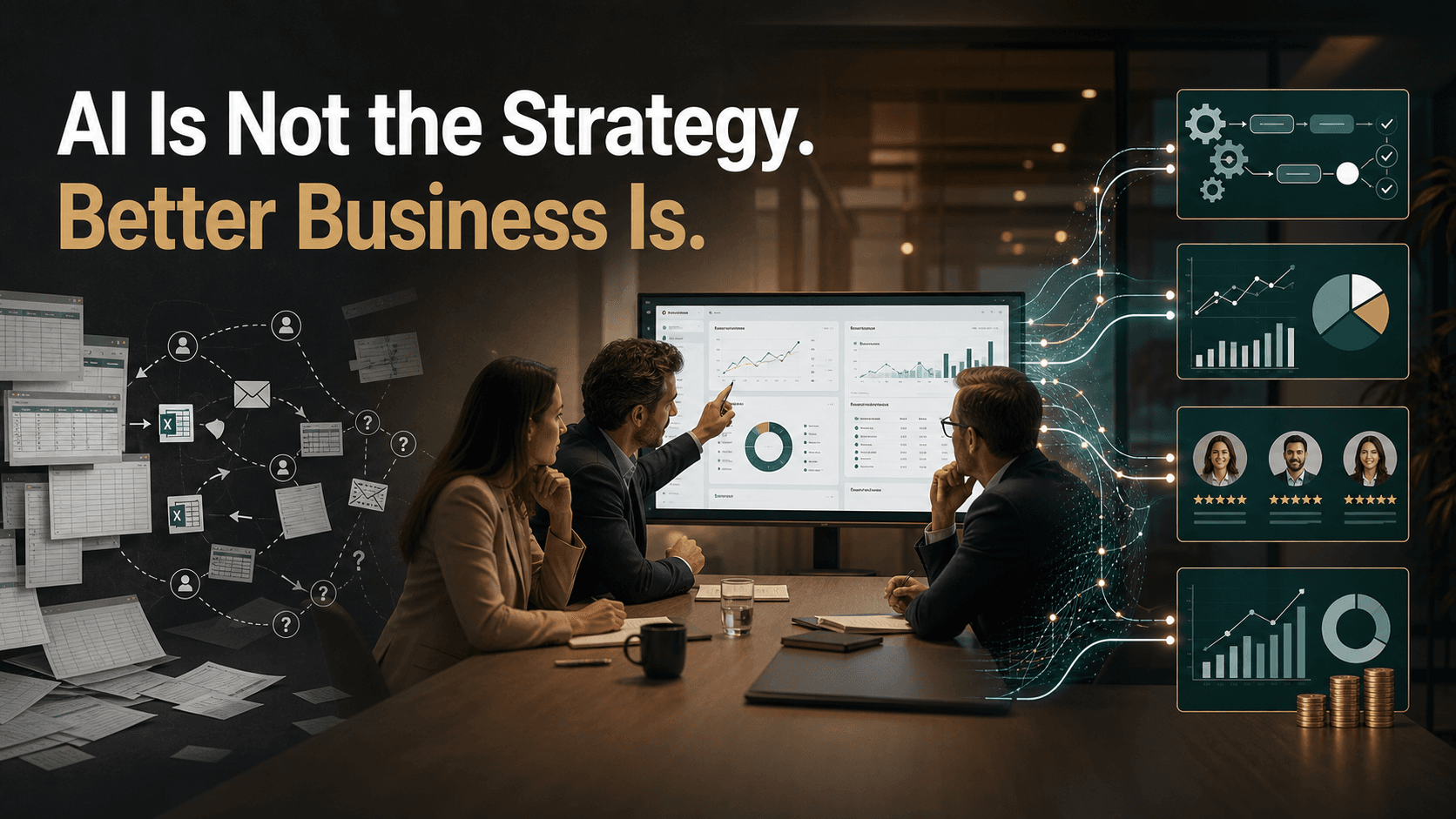
AI is everywhere at the moment. Every boardroom, founder conversation and leadership meeting seems to have the same question somewhere in the background: how should we be using AI?
It is the right question, but often asked in the wrong way. AI is not a magic bullet. It will not fix unclear processes, poor data, weak ownership, disconnected systems or teams that do not know what decision they are trying to make.
In fact, if a business adopts AI without understanding the operational reality underneath, it can make those problems worse.
The real opportunity is not adding AI. The opportunity is understanding where a business is losing time, margin, visibility or momentum.
Then the work becomes practical: apply the right mix of process improvement, automation, software and AI to solve something that genuinely matters. That is the work we do at Belscar.
Start With The Operating Reality
With a luxury retail client, the challenge was not simply more technology. It was understanding how inventory, seller intake, authentication, photography, listing, customer engagement and retention all connected.
The value came from seeing the business as an operating system: where items flowed, where momentum slowed, where customer communication mattered, and where automation could support a stronger commercial rhythm.
In another current project, the opportunity is around replacing fragmented spreadsheet-led operations with a connected business platform. Finance, retail, design, reporting and leadership visibility all depend on having a single version of the truth.
The useful work is not adding AI on top of chaos. It is understanding the workflows, data, responsibilities and decision points first, then deciding where automation and AI can make decisions faster, reduce manual effort and give leadership a clearer view of the business.
The Pitfall: Innovation Theatre
Bad AI adoption usually starts with a tool. Someone buys software, tests a chatbot, asks teams to use AI more, or bolts automation onto a process nobody has properly mapped.
The result is often more noise, more exceptions, more confusion and very little measurable value.
Good AI adoption starts with the business. What decisions need to be faster? What manual work is slowing the team down? Where is data being re-keyed, reconciled or chased? Which customer moments are being missed? Where would better visibility change behaviour? What should stay human, because judgement and trust matter?
Only then should the technology enter the conversation.
Where Belscar And CXOStudio Fit
CXOStudio is a separate business that Simon co-founded. It is a partner of Belscar, with a broader transformation brief.
CXOStudio brings together experienced operators, strategists, financial leaders and AI-native builders. The focus is not generic consulting and not simply development. It is operator-led transformation: diagnose the bottleneck, design the future operating model, build practical capability, enable the team, and keep improving it.
At Belscar, we bring the practical systems lens: operational clarity, workflow control, dashboards, automation, customer-facing products and hands-on delivery.
CXOStudio adds the broader AI-native transformation model: fractional CXO capability, strategic diagnosis, rapid build sprints, adoption support and access to a wider bench of specialist expertise.
M&A Readiness Needs Leadership Capacity
That fractional leadership model becomes especially relevant for companies preparing for an M&A process, considering a sale, or moving toward investment.
In those moments, leadership capacity matters. Buyers and investors want confidence that the business is not dependent on a small number of over-stretched individuals, fragile workflows or undocumented knowledge.
They want to see operational control, commercial clarity, reliable reporting and a team that can execute through scrutiny.
CXOStudio can support that process in two ways. For some businesses, it can bolster the existing leadership team on a fractional basis, adding experienced capability across technology, operations, finance, commercial growth and product without the cost or delay of full-time senior hires.
For others, it can provide a ready-made, experienced operational leadership team around the company: people who understand how to professionalise systems, strengthen reporting, improve execution and support the business through preparation, diligence and post-deal transition.
That is not just useful for the transaction. It is useful because the business becomes better run.
The Practical Test
AI should shorten a loop the business already cares about. It should help a team make better decisions, reduce avoidable admin, improve customer experience, increase visibility, or support growth the business can actually handle.
If it cannot be tied to one of those outcomes, it probably does not belong in the first phase.
The businesses that will benefit most from AI are not necessarily the ones chasing the newest tool. They are the ones prepared to ask harder questions about how they actually operate.
Questions worth asking
- Where are we relying on spreadsheets that only one person understands?
- Where are teams working from different numbers?
- Where are customers waiting because internal handoffs are slow?
- Where are leaders making decisions without a current view of the business?
- Where is growth being constrained by operational drag?
- Would the current operating model stand up to diligence?
- Can the leadership team show reliable visibility across performance, risk and opportunity?
That is where AI becomes useful. Not as a headline. Not as a gimmick. Not as a magic bullet. As part of a better operating model.
That is what we are building with clients now: practical, measurable, human-centred systems that help companies understand where AI can genuinely improve the way they work. And just as importantly, where it should not.
Start with the business problem.
If you are exploring practical AI, operational automation, or fractional leadership ahead of growth, investment or sale, start with a short discovery conversation.